
Full Article |
|
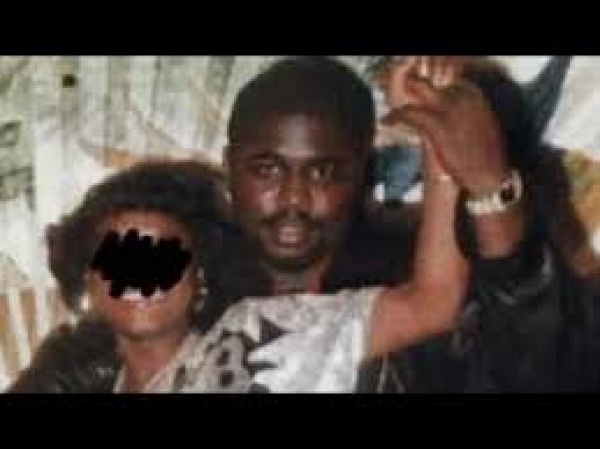
Jones, who by that time was 28 years old, didn’t take the indictment lying down. With word of the upcoming bust reaching him by Thanksgiving, Butch scooped up his wife, Portia, who would also end up being charged in the case and his two kids and re-located to a mansion he had recently bought in Arizona. Encouraging his attorney Richard Lustig to make a deal with prosecutors, Jones turned himself into federal custody on March 22 1983, agreeing to plead guilty as being head of a continuing criminal enterprise in exchange for a sentence of 12 years in prison. Most of Jones’ underlings followed suit with their boss’ inclination and pled guilty to the charges and however two of his Wrecking Crew enforcers, Karl “Fat Pratt” Gatlin and Kevin “Lughead” Wilson, couldn’t take the heat of the bust and both turned witness for the government.
The crushing legal assault on YBI, unfortunately, did little to temper the violence the gang exhibited and although it shook the organization to the core there were still enough remnants to keep things active within the ranks for another five years. Immediately following the indictment and subsequent guilty pleas, further friction developed between Butch and Baby Ray. With Butch locked up and Peoples out on bail awaiting sentencing, the pair are alleged to have bumped heads over how the gang would be governed and previous earning distributed with the entire original administration either currently or soon to be behind bars. This feverish dispute was complicated by the fact that Baby Ray’s brothers, Timothy “Timmy Slim” Peoples and Nathaniel “Nate the Great” Peoples, were both key members of Butch’s crew. Timmy Slim was viewed as Butch’s top emissary, often acting as Jones’ eyes and ears on the streets.
According to federal documents, Butch wanted to tidy some things up within the gang before everyone turned themselves in to start serving their prison time. Most of the tidying, the documents say, related to Jones wanted to eliminate certain members of Baby Ray’s inner-circle who were unscathed by the recent bust. On May 12, 1983, Moe Heart Gibbs, one of Butch’s closest confidants and his first cousin and Kurt McGurk, whose nickname derived from an obscure one-time comic strip character from the early-1970 and who was free on bond at the time resulting from the December 1982 indictment, ambushed Joseph “Wamp” Brown, Gregory “Special K” Kendricks, two of Peoples’ top henchmen, on separate street corners in the same afternoon. Brown was killed when McGurk shot him on the corner of Concord and Benson, but Kendricks survived his attack on the corner of Beaubian and Erskine. Right before he died, Wamp told police that “Kurt McGurk and Mohawk (another alleged nickname of Gibbs) shot me”, leading the judge in his drug case to revoke both of their bonds and issue arrest warrants.
Gibbs, also indicted in the 1982 case, turned himself in and was eventually acquitted of the charges. Not surprisingly, McGurk, described by street informants as a “blood thirsty psychopath,” who had been doing hits for the gang since he was 15 years old, went underground. While at large, he made front page headlines twice; first, in September for taking aim at a pair of uniformed police officers with a sawed off shot gun in the midst of fleeing on a foot from an alley on Richton and Cortland on Detroit’s near Northwest side and then shortly thereafter by allegedly sending a letter containing a death threat to Gil Hill, the Detroit Police Department Chief of Homicide.
A citywide manhunt for Kurt McGurk ensued, with the 19-year old hitman being declared Public Enemy No. 1 by the Wayne County Sherriff’s office. He was finally apprehended in November and pled guilty to the Brown murder following a high-speed chase that took police from Pontiac onto I-75 before finally ending on the lawn of the D’arcy-McManus & Masius advertising agency on Woodward in Bloomfield Township.
The coming years didn’t bring peace or stability to the then-already iconic criminal empire. Further housecleaning was deemed necessary and through the first half of 1984 there were six gangland homicides attributed to backbiting between the gang’s quickly emerging two factions. Before the end of the year there were three more. Looking to drive a stake right through the heart of Baby Ray’s powerbase, Butch’s crew killed Norman “Snead” Johnson, a Peoples associate on February 17 and then Carl Garrett, his one-time bodyguard and driver, on July 17, gunned down as he rode a moped at the intersection of 6 Mile Road and Schaeffer.
Just two months prior in May, Ricky Gracey and two other assailants – all said to be Peoples loyalists – robbed Butch Jones’ suburban Troy residence, where his wife and children were staying when he was imprisoned and then tried to rob it again two days later. The second robbery attempt was thwarted, according to court testimony, when Butch’s wife Portia – on probation for her role in the 1982 bust – shotgunned Gracey as he ran from the house. Butch’s son, “Mo Mo”, who was only 10 years old at the time, is alleged to have possibly taken place in the shooting as well and in court testimony begged his mother to let him finish the wounded Gracey off with his own weapon.
Instead, Portia Jones called for help from “The A Team,” to dispose of Gracey. Arriving on the scene to aid Jones’ family were Charles “The Big 0” Obey, Spencer Holloway and Andre Williams. Led by Obey, the A Team tortured Gracey for the names of his co-conspirators and, according to Williams, who turned against the gang in court, killed him by unloading a Uzi clip into his body and leaving his mangled corpse in an Eastside alley on Cardoni and Russell Streets.
Garrett’s death was linked to the planning of the heist. Prior to Garrett’s murder in June, his stepfather, Dennis Bankston, who authorities also connected to the failed robbery, was found slumped over the steering wheel of his car, shot to death in a parking lot on the Northeast side of the city. The week following Garrett’s murder, Reggie Stringer, another suspected accomplice in Gracey’s break-in, was found dead in his car on Winder Street from multiple gunshot wounds to his head and body.
Baby Ray Peoples came out of jail on parole at the age of 29 in late-April of 1985 and, at least according to his family tried to go straight. He got married in June and was looking to get involved in the real estate business. It never happened. The past, specifically and most-likely his beef with Butch Jones caught up with him on August 10 when he was killed, shot to death sitting in his beige-colored Chevy Citation waiting to meet an associate on in an alley on Sturdevant Avenue, in between La Salle and 14th Street.
Even following the Davis and Peoples homicides and the jailing of Jones and McGurk, the government remained aggressive in its pursuit of bringing down whatever left of the organization there was. In both 1985 and 1987, investigation’s dubbed “YBI II” and “YBI III” respectively, were capped with sweeping federal racketeering indictments, the latter of which spelled the official demise of the megawatt drug organization.
And for a while, things on the YBI front were dead. And then Butch Jones got released from prison.
Back on the scene in the city of Detroit in the early-1990s, after eight years behind bars for his role in being the convicted ringleader of the uber-notorious YBI gang, Butch had no intention of going clean. Despite spewing rhetoric of his supposed rehabilitation to the press and telling tales of wanting to do everything in his power to dissuade young kids away from a life on the streets, Jones went back into the drug and murder business.
Joining forces with John “The Bread Man” Bass, a much-feared crime lord who had emerged when he was off serving his time in prison, Butch joined and eventually seized control of, “The Dawg Pound”, a smaller, yet eerily-similar narcotics to YBI, which headquartered its operations out of a series of residences on Monterey Avenue, right back in the epicenter of his old stomping grounds. Just like in the 80s, there was drug dealing, fierce intimidation tactics and often coldblooded murder.
Although Jones has never been convicted on any specific counts of homicide, police files estimate that the legendary urban Godfather, referred to in some newspaper accounts as the “Henry Ford of heroin,”, can be linked to the planning, ordering and/or carrying out of some 75 gangland executions.
Similar to what happened back in 1978 when Butch came out of prison to muscle his way to the top of an already-functioning crime conglomerate, Jones basically showed up on Bass’s doorstep and declared himself in for half of the Dawg Pound organization. Too enamored and intimidated to refuse his declaration, Bass welcomed Butch on board with a smiling face and an extended hand, knowing at the very least being associated with the former YBI boss could only increase his street cred.
However, unlike in his YBI days when he was alleged to have killed his way to complete leadership supremacy, Jones assumed command of the Dawg Pound due to simple good luck. Working relatively well in cahoots with each other, Jones and Bass co-existed peacefully for about five years before the Bread Man was brought down by a crippling federal bust in February 1997, allowing Butch to be on top of the gang’s power structure all alone. Included in the indictment were charges that Bass ordered the June 1996 murder of his partner and half-brother Patrick “Pat the Ram” Webb, carried out by Dawg Pound lieutenant Armenty “Fat Moe” Shelton, who then four days later was killed by Bass himself in order to cover his tracks.
From 1994-2001, Butch Jones oversaw a large-scale marijuana and cocaine distribution network that committed at least two murders of rival dealers. Based on his name and reputation alone, Jones was also allegedly able to strong arm his way into the extortion racket, simply taxing other drug organizations for doing business in his neighborhood. By way of his association with Bass, Butch was also reputed to have gotten into the world of dog fighting, one of the derivatives of the gang’s moniker. Indicted in the summer of 2001, the U.S. Prosecutors Office declared its intention to seek the death penalty against him, but again, just like back in 1983, thanks to some nifty lawyering, he walked away with a lesser than expected penalty of 30 years incarceration. With time off for good behavior, Butch could be home by the mid-2020s, getting the chance to live out his final days amongst his friends and family at home.
If Young Boys, Incorporated was the McDonalds of the Motor City drug trade, then the “Pony Down Gang”, “The Davis Family Gang” and “The Curry Brothers Gang” were the Burger King, Wendy’s and Kentucky Fried Chicken. These narcotics franchises might have lived in the shadows of Butch Jones and YBI, but they were just as dangerous, successful and violence-prone with simply less headlines.
“Those gangs were all copying the blue print of YBI,” De Fauw said. “That said, they were wreaking equal amounts of havoc within the city limits. While at one time, you might have had only a small handful of big time organizations, by the 1980s, these type of groups were sprouting up all over the place, simply following the path set by the Young Boys.”
The only one of these gangs who actually tried to take the Young Boys on head-to-head was the Pony Down crew. While the Davis’ and the Curry’s carved out obvious non-YBI territory for themselves to make a living, the Pony Down gang had the gall to plant its flag in the middle of the Young Boys well-established Westside turf, start poaching their roster of employees and enter into direct competition with them by trying to undercut their prices. From the very start, it was war.
Pony Down was started by Leroy “Gun” Buttrum and got its name from the gang’s trademark Pony-brand shoes and athletic gear, worn in direct and purposeful contrast to YBI’s signature Adidas-brand ensembles. Unlike Butch Jones, Baby Ray Peoples and Block Marshall, who were all basically teenagers when they started YBI, Buttrum was just short of his 30th birthday when he founded Pony Down in 1980.
A junior high school dropout, Buttrom took his first arrest in 1964 at the age of 14 for burglary. He wasn’t yet 16 when he had already stacked up a rap sheet that included charges of auto theft and assault with intent to commit murder. In 1970, he took a bust for assault with intent to commit armed robbery and sentenced to five years in prison, of which he served three. Paroled in 1973, Buttrom went temporarily legit, coming back to Detroit and starting a home improvement business, helping rehab houses. It didn’t stick.
Building his own drug empire in the exact same mold and using an identical business model as his future adversaries in YBI, Gun Buttrum recruited his best friend Robert “Bobby the Pimp” Lantine, his three brothers, Walter Buttrum, Larry “LB” Buttrum and Tony “The Snake” Buttrum and several one-time Young Boys soldiers and by mid-1980, the Pony Down gang was up and running in full-swing. Buttrum immediately had dozens of adolescent street dealers posted across Seven Mile Road on the far Northwest side of the city slinging his own brands of slickly-marketed heroin, sporting flashy names like, “GQ”, “Shotgun Special”, “Papa Smurf”, “Nod City” and “Devil’s Dust.” Gang members, at his best, raided and destroyed YBI drug houses, telling YBI dealers they could either “Pony down or pack up and leave town.” This meant they could join up with the new crew of drug bandits and turn their backs on YBI or get out of the business all-together.
The phrase, “I Pony Down” was spray-painted everywhere possible, especially on YBI property. Handwritten YBI fliers advertising its new brand of drugs and certain buy-one, get-one free deals were ripped down from the housing project hallways and street posts and replaced
with similar paraphernalia sponsored by the Pony Down boys. These aggressive leadership tactics were more than fruitful though as authorities placed the gang’s profit margin at $100,000,000 annually.
Moving out of the city and into a quaint, residential manor in suburban Farmington Hills, Gun Buttrum went around calling himself the “new and improved Butch Jones,” outwardly showing his disdain for the YBI kingpin, while at the same time mimicking practically every single one of his ruling- methods. It was a contradiction that didn’t escape Jones and his compatriots and only fueled the bitter rivalry.
Tensions simmered under the surface for a while, then in late-1982, when YBI was under siege from the government, a series of violent altercations broke out between the battling drug syndicates – mostly drive-by shootings – with Buttrum and his Pony Down crew making a move to seize territory when their rivals were at their weakest. After New Year’s, the hostility increased and bodies started to drop.
Source: gangsterreport
Date Posted: Tuesday, June 2nd, 2015 , Total Page Views: 16090
Like what you're reading? Please help us continue providing you with informative and thought provoking stories by becoming a supporter of Moorenews.net
 Got A Story To Share? Click here to submit your story to us.


